Courier proof
A missing parcel insurance claim, fully evidenced
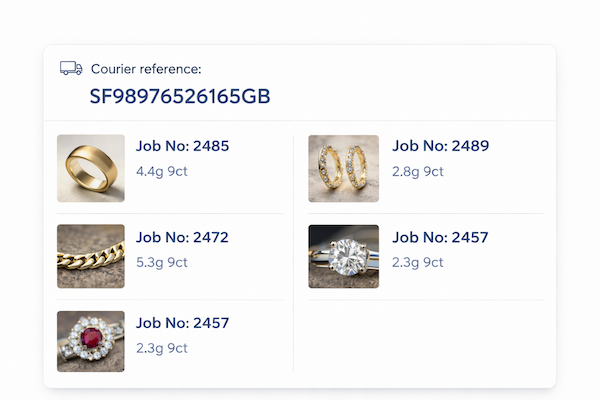
One jeweller produced a full itemised claim pack with photos, weights, condition notes, and parcel timeline evidence.
Jump to sectionSee real workshop scenarios where Flow helped teams resolve disputes, recover from handover mistakes, and keep customer confidence with evidence-led job records.
These are the moments that cost money, time, and trust - when a parcel goes missing, a customer disputes an item, or two similar jobs cross paths. Flow keeps the facts attached to the job, so you can resolve issues fast and keep work moving.
Click a card to jump to the story and the outcome.
One jeweller produced a full itemised claim pack with photos, weights, condition notes, and parcel timeline evidence.
Jump to sectionA real case where timestamped booking-in photos (with ruler reference) resolved a return dispute without conflict.
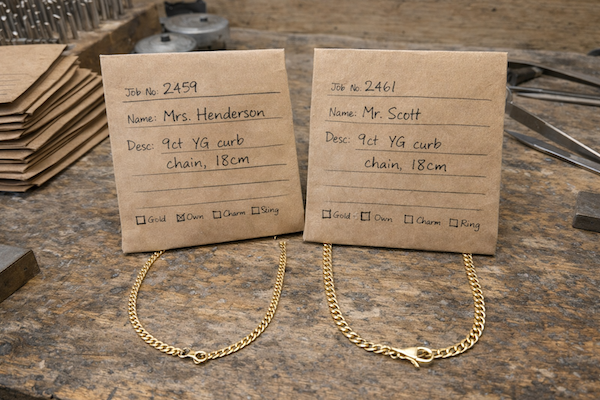
Jump to sectionA real packet mix-up was identified and corrected fast using job photos and searchable records.
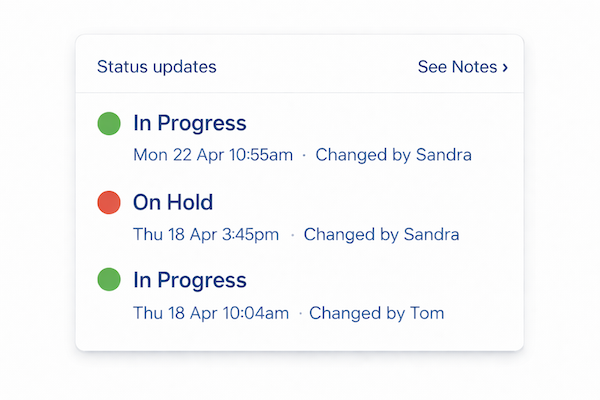
Jump to sectionA real case where status history exposed a tray handoff miss and helped the team recover the job quickly.
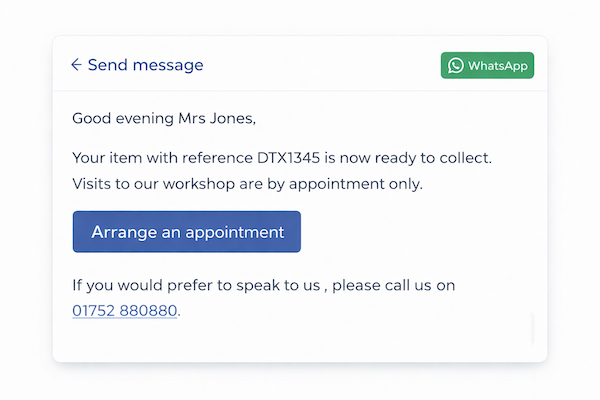
Jump to sectionAn appointment-only jeweller turned ‘ready for collection’ calls into one-click SMS/WhatsApp updates with a booking link.
Jump to sectionOne Flow workshop sent a parcel by courier and it went missing in transit. To make an insurance claim, they were asked for proof of exactly what was inside, each item's condition, and when those items were placed into that parcel.
This is a real courier insurance claim scenario. The key outcome was trust through evidence: the workshop could prove what was sent, in what condition, and when it was associated with the parcel.
A customer returned and said the stone looked different in colour, with a visible inclusion on the table that they believed was not there before. These moments are usually about concern, not accusation, and they need calm, evidence-led handling.
This scenario is about proving item continuity from booking in to collection. The objective is trust and clarity, not confrontation.
Two packets reached finishing and quality control at roughly the same time. Both were described similarly ('9ct YG curb chain, 18cm'), and the chains were returned to the wrong packets. When the first customer arrived, they immediately said, 'that's not my chain.'
Mix-ups can happen in busy workshops, especially with near-identical descriptions. The advantage is not pretending errors never happen, but being able to fix them quickly, transparently, and with evidence.
A customer approved an estimate by phone. Office staff updated the status in Flow to proceed, but in a busy period forgot to move the physical packet from the Estimates tray into In Progress. A few days later, the customer asked for an update and the team couldn't locate the job where they expected it.
This case is about operational clarity when process and reality drift apart. The value is not avoiding all human error; it is being able to reconstruct what happened quickly and reliably.
One Flow jeweller runs by appointment only and does not accept public walk-ins. Each completed job used to trigger manual admin: find number, call, wait for an answer, agree a slot, and chase missed calls or voicemails.
This scenario shows how communication templates can remove repetitive collection admin. The gain is not just speed, but fewer dropped handovers between message, diary, and customer follow-up.
Start setup when you are ready, or book a short demo and we will map Flow to your real process.
We use essential cookies to make the website work and optional analytics cookies to improve it. You can accept, reject, or customise analytics cookies.
Read our Privacy Policy.