What Is Jewellery Repair Software? A Guide for Jewellers
A practical guide to jewellery repair software for jewellers, watchmakers and workshops, covering job tracking, photos, statuses, due dates and customer updates.
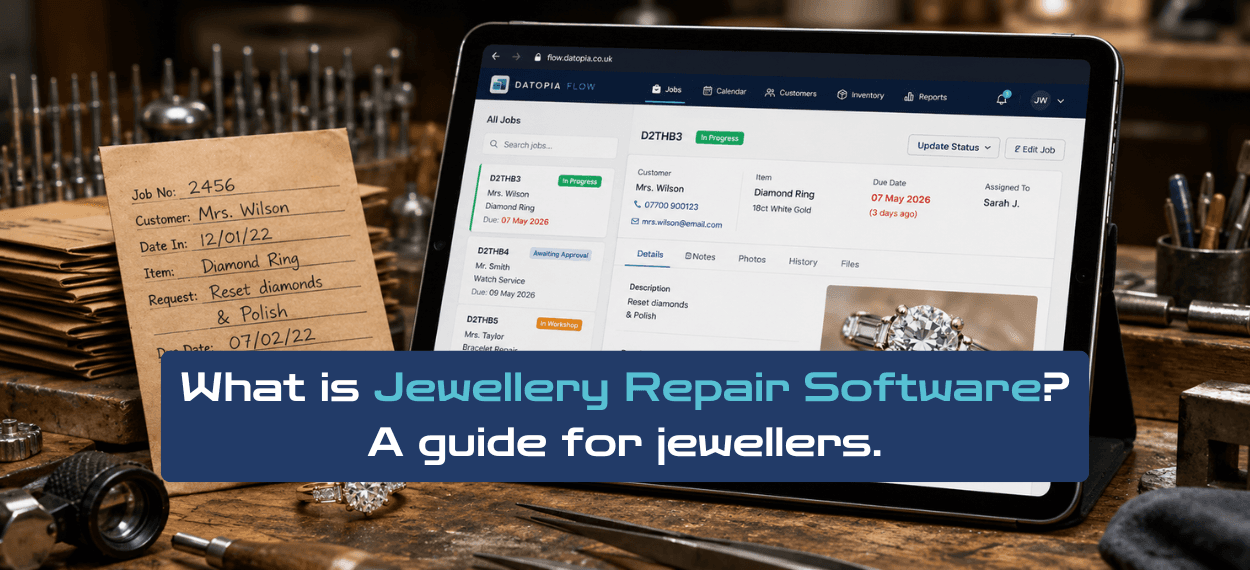
Jewellery repair software is repair tracking software for jewellers, watchmakers, goldsmiths and workshops. It helps manage repair jobs from customer intake through to workshop work, progress updates, completion and collection.
Good jewellery repair software does not have to replace the physical workshop habits that already work. It should support them by making job information easier to find, easier to update and easier to share with the right people.
If your workshop is struggling with missing packets, unclear job statuses, customer update calls, overdue repairs or disconnected communication between retail and bench teams, Datopia can help you assess whether Flow fits your repair process.
Talk to Datopia about Flow
TL;DR
- Jewellery repair software helps manage repair jobs from intake to collection.
- It is used by retail jewellers, watchmakers, goldsmiths, trade repairers and workshops.
- Common features include job records, customer details, statuses, due dates, photos, staff assignment, workshop notes, QR codes and job history.
- It can reduce reliance on memory, spreadsheets, notebooks and paper-only systems without forcing a workshop to abandon physical packets.
- The main benefit is visibility: staff can quickly see what a job is, where it is, who is responsible, what has been agreed and what needs to happen next.
- Jewellery repair software is not always the same as POS software. Some systems include POS, while others focus specifically on repair tracking and workshop flow.
- Datopia Flow is an example of jewellery repair tracking software built around real workshop needs, including fast lookup, repair records, status tracking, photos, due dates, QR job labels and controlled trade partner sharing.
What Does Jewellery Repair Software Do?
Jewellery repair software records and tracks the information needed to manage a repair safely, clearly and consistently.
Instead of relying only on handwritten packets, spreadsheets or individual staff memory, the software creates a digital job record. That record can follow the repair from the first customer conversation to workshop assessment, approval, completion and collection.
Typical repair records may include:
- customer name and contact details
- item description and identifying features
- requested repair work
- repair notes and workshop instructions
- item condition at intake
- photos or uploaded packet images
- due dates and priority
- assigned staff member or workshop area
- current job status
- customer communication history
- collection and completion details
The goal is not to make jewellery repairs feel less personal. It is to make the practical information around each repair easier to control.
A repair job is rarely just a task. It is a customer relationship, a valuable item and a chain of promises that need to be remembered accurately.
Who Uses Jewellery Repair Software?
Jewellery repair software is used by businesses that need a clearer way to manage repair, restoration, alteration or service work.
That can include:
- independent retail jewellers
- watchmakers
- goldsmiths
- jewellery repair workshops
- trade repair providers
- jewellery designers handling aftercare work
- multi-staff stores with front-of-house and workshop teams
- businesses that send repairs between retail, workshop and trade partners
The need usually appears when repair volume grows beyond what can comfortably be managed with paper packets, notebooks or a single person’s memory.
A small workshop may need software because every repair has important details. A larger retail jeweller may need it because several people are involved in the same job at different points.
It is not only for large jewellery chains. A single-site jeweller can benefit if several people handle repairs, if jobs are regularly chased by customers, or if repair information is split between packets, photos, notes and memory.
Why Do Jewellers Need Repair Tracking Software?
Jewellers need repair tracking software because repair work carries operational, customer service and documentation pressure.
A jewellery repair is often time-sensitive, detail-heavy and emotionally important to the customer. It may involve a sentimental ring, a valuable watch, a bespoke alteration, a missing stone, a fragile chain or a piece that needs careful condition recording before work begins.
Common problems jewellery repair software helps with include:
- staff not knowing where a repair is
- repair packets being difficult to find
- unclear due dates
- customers calling for updates that take time to answer
- workshop notes being split across paper, messages and memory
- photos not being stored with the job
- uncertainty over what was agreed at intake
- difficulty finding old repair history
- trade partner communication becoming disconnected
- managers lacking visibility of workload and bottlenecks
Paper systems can still be effective in the right workshop. The issue is usually not paper itself. The issue is when paper becomes the only source of truth and the business cannot quickly search, filter, share or audit repair information.
What Features Should Jewellery Repair Software Include?
Good jewellery repair software should make the repair process easier to manage without adding unnecessary admin.
Important features include:
- Repair job records: a central record for each repair, alteration, restoration or service job.
- Customer details: contact information, repair history and customer-specific notes.
- Item information: descriptions, identifying marks, condition notes and repair requirements.
- Photos: intake images, before-and-after photos, packet uploads and supporting documentation.
- Repair statuses: clear stages such as received, assessed, awaiting approval, in workshop, completed or ready for collection.
- Due dates: target dates that help staff prioritise and spot overdue work.
- Staff assignment: visibility over who owns or is working on each job.
- Workshop notes: practical instructions for bench jewellers, watchmakers or repair teams.
- Search and filtering: fast lookup by customer, job number, status, date or item detail.
- QR codes: scannable job labels that connect physical packets or items to digital records.
- Job history: a record of previous work, updates and completed repairs.
- Trade partner sharing: controlled access where external repairers or trade partners need to see relevant job information.
Some jewellery repair platforms also include POS, inventory, payments, ecommerce or accounting integrations. Those features can be useful for some retailers, but they are not the core definition of jewellery repair software.
The core question is simpler: can your team find, update and trust the repair information when they need it?
How Does Jewellery Repair Software Work in Practice?
Jewellery repair software usually follows the same broad journey as a real repair job.
- Intake: the repair is logged with customer details, item information, photos, condition notes and requested work.
- Assessment: the workshop or responsible staff member reviews the job and adds technical notes, estimates or next steps.
- Approval: the customer may approve the estimate, scope or timescale before work continues.
- Workshop progress: the job status is updated as it moves through repair, polishing, setting, watch work, quality control or another internal stage.
- Customer updates: staff can see what is happening and update the customer without searching through packets or asking several colleagues.
- Completion: the job is marked as complete or ready for collection.
- Collection and history: the completed repair remains searchable for future reference, aftercare or repeat work.
The best systems make this workflow feel familiar. They should not force a jeweller to operate like a generic ticket desk. Jewellery repairs have their own vocabulary, risks and workshop realities.
Does Jewellery Repair Software Replace Paper Packets?
Jewellery repair software does not have to replace paper packets completely. In many workshops, the best setup is a hybrid process where physical packets, envelopes or labels still move with the item while the key information is stored digitally.
This matters because paper has real advantages:
- it is visible on the bench
- it is familiar to staff
- it can physically travel with the item
- it works well for quick workshop handling
- it suits long-established repair habits
The weakness is that paper is hard to search, share, back up and report on. If a customer calls for an update, someone may need to locate the packet or interrupt the workshop. If a packet is misplaced, the business may lose context. If photos are stored separately, condition evidence may be harder to find later.
Datopia Flow is designed around this reality. It can support physical repair packets while adding digital lookup, photos, statuses, due dates, QR job labels and job history.
The strongest repair software should improve control without making a good workshop feel like it has been rebuilt around software.
Is Jewellery Repair Software Better Than a Spreadsheet?
Jewellery repair software is usually better than a spreadsheet when repair jobs need photos, statuses, accountability, search, history and multi-person visibility.
Spreadsheets can work well at the beginning. They are flexible, familiar and inexpensive. But they often become difficult when several people need to update repairs, when photos need to be attached, when jobs need clear status changes or when customer communication needs to be tracked.
A spreadsheet may be enough if:
- repair volume is very low
- one person manages every job
- photos and condition records are handled separately
- no one needs structured reporting
- customer update requests are easy to answer
Dedicated repair software is usually stronger if:
- several staff members handle repairs
- repair packets are sometimes hard to locate
- customers regularly ask for updates
- jobs have due dates and priorities
- photos are important for condition records
- trade partners or external workshops are involved
- management needs visibility over workload
The decision is not about whether spreadsheets are bad. It is about whether they still match the complexity of the repair process.
Is Jewellery Repair Software the Same as POS Software?
Jewellery repair software is not always the same as POS software. POS software handles sales transactions, payments and retail operations, while jewellery repair software focuses on tracking repair jobs, workshop progress and customer repair information.
Some platforms combine repair management with POS, inventory and payments. That may suit a store that wants one broad retail system.
Other jewellers prefer dedicated repair tracking because they already have a POS system, do not want to change their retail setup or need deeper control over workshop flow rather than sales processing.
Datopia Flow is not positioned as a POS replacement. It is focused on jewellery repair tracking and workshop visibility, helping teams manage repair jobs, customer information, photos, statuses, due dates, QR codes and trade partner sharing.
If you already have a POS system but repairs still feel difficult to track, Datopia can talk through how Flow could sit alongside your existing repair process.
Ask Datopia about repair tracking with Flow
What Should You Look for When Choosing Jewellery Repair Software?
When choosing jewellery repair software, look for a system that fits how your workshop actually works, not just a long feature list.
Use these criteria when comparing options:
- Repair-specific workflow: does it understand jewellery, watch and workshop jobs?
- Fast job lookup: can staff quickly find a repair while a customer is waiting or calling?
- Clear statuses: can everyone see where a job is in the process?
- Photo handling: can intake photos, condition images and supporting files be stored with the job?
- Due date visibility: can overdue or urgent jobs be spotted quickly?
- Ease of use: will front-of-house and workshop staff actually use it?
- Physical workflow support: can it work alongside packets, labels or existing bench habits?
- Customer communication support: does it make updates easier and more consistent?
- Trade sharing: can relevant job information be shared securely where external repair partners are involved?
- Scalability: can it handle more jobs, staff or repair categories as the business grows?
Also ask what the software is not trying to do. A focused repair tracking system may be better than a large all-in-one platform if your main problem is repair visibility rather than retail checkout.
How Does Datopia Flow Fit Jewellery Repair Software?
Datopia Flow is jewellery repair tracking software built to help jewellers and watchmakers manage repair jobs without losing sight of the physical workshop process.
It is designed for businesses that need better visibility over customer repairs, workshop flow, item condition records, identifying features, job progress and customer experience.
Datopia Flow can support:
- repair and customer records
- workshop notes
- repair statuses
- job due dates
- fast repair lookup
- photos and uploaded packet images
- QR job labels
- job history
- batch and bulk actions
- trade partnership job sharing
- clearer customer and workshop communication
Flow has also been shaped by feedback from real jewellery repair use. Andrew Berry Jewellery uses Datopia Flow to manage jewellery repairs, customer communication, workshop flow, item condition records, identifying features, job progress, productivity and customer experience. Their feedback has influenced improvements including QR job label printing, trade partnership job sharing, batch and bulk actions, job life-cycle UX improvements and photographic upload annotations.
That kind of feedback matters because jewellery repair software should be built around repair reality, not only generic task management.
If you want to see whether Flow would suit your shop, workshop or trade repair process, book a focused discussion with Datopia.
Book a Datopia Flow discussion
What Are the Signs Your Workshop Needs Jewellery Repair Software?
You may need jewellery repair software if repair management is starting to depend too heavily on one person, one notebook or one physical location.
Common signs include:
- staff need to search for packets before answering customer questions
- repair updates interrupt bench work
- overdue jobs are found too late
- jobs are difficult to prioritise
- photos are stored separately from repair notes
- customer details are repeated across systems
- trade repair updates are handled manually
- no one has a clear view of workshop workload
- repair history is hard to retrieve
- front-of-house and workshop teams are not seeing the same information
These problems usually appear gradually. A system that worked well for 20 repairs a month can become strained at 100, especially when several people are involved.
The right software should make the repair process more visible without making it heavier.
FAQs
What is jewellery repair software?
Jewellery repair software is a digital system for tracking jewellery and watch repair jobs from intake to completion and collection.
It usually stores customer details, item descriptions, repair notes, photos, due dates, statuses and job history so staff can find and update repair information quickly.
What is the best jewellery repair software?
The best jewellery repair software is the system your team will actually use consistently. For repair-heavy jewellers, that usually means fast job lookup, clear statuses, due dates, photos, workshop notes, customer repair history and support for the way repairs physically move through the business.
For repair-heavy jewellers, the best fit is often the system that makes repair intake, job lookup, status tracking, photos and customer updates easiest for the team to use consistently.
What technology is used in the jewellery industry?
Jewellery businesses use a mix of POS systems, CAD tools, ecommerce platforms, repair tracking software, CRM systems, stock management tools, accounting software and digital communication tools.
For repair workshops specifically, the most relevant technology is usually job tracking software, photo records, QR labels, customer communication tools and searchable repair history.
What apps do jewellers use?
Jewellers may use apps for sales, inventory, design, repair tracking, customer communication, accounting, marketing and ecommerce.
A repair-focused jeweller may use a dedicated system such as Datopia Flow to manage repair jobs, statuses, due dates, photos, job notes and workshop visibility.
What is CRM in the jewellery industry?
CRM in the jewellery industry means managing customer relationships, customer details, purchase history, repair history, preferences and communication.
For repairs, CRM value comes from being able to see who the customer is, what item they brought in, what was agreed, what work has happened before and how they should be updated.
Can AI replace jewellery repair tracking software?
AI can help with writing, marketing, admin and analysis, but it cannot replace accurate repair records.
A jewellery repair business still needs reliable job data, condition photos, due dates, statuses, workshop notes and accountability.
Can jewellery repair software send customer updates?
Some jewellery repair software can help with customer updates, while others focus mainly on internal tracking.
Even where updates are not fully automated, having clear statuses and searchable job records makes it much easier for staff to answer customer questions quickly and consistently.
Can jewellery repair software track watches as well as jewellery?
Yes, many repair tracking systems can be used for watches as well as jewellery, provided the system can record the right item details, notes, photos and status stages.
Watch repairs often need careful condition records, identifying features, due dates and workshop notes, so they benefit from the same visibility as jewellery repairs.
Does jewellery repair software work for trade repair partners?
It can, if the software supports controlled sharing or a workflow designed for external repair partners.
This is useful where a retail jeweller sends work to a specialist workshop, watchmaker, setter, polisher or other trade provider and needs clearer visibility across the job lifecycle.
Ready to Make Jewellery Repair Tracking Easier?
Jewellery repair software is most valuable when it helps your team answer simple but important questions quickly: where is the job, what was agreed, who is handling it, when is it due, what condition was it in and what needs to happen next?
For some jewellers, paper packets and spreadsheets still work well. For others, the repair process has become too busy, too distributed or too dependent on memory.
Datopia Flow is built for jewellers and watchmakers who want better repair visibility without losing the practical workshop habits that already work.
If missing packets, customer update calls, unclear statuses, overdue repairs or disconnected retail and workshop communication are starting to slow your team down, Datopia can help you map the next step.
Discuss a Flow demo or roadmap

